Tuesday, 1 May 2012


India's Economic Development and

 Population Growth


We now have the provisional population totals for 2001 Census and the first thing that strikes us is that we went wrong. In February 2001, we have a population of 1.027 billion. But there were earlier projections that stated we would touch 1.027 billion in 2002. So the projections have gone wrong ad we probably touched the billionth mark almost a year before we officially did so. Someone other than Astha Arora should have become famous.
The decadal population growth for 1991-2001 is 21.34%, implying an annual average growth rate of 2.134%. This is of course an annual average growth rate for the decade as a whole and is not terribly pertinent. What is much more important is hat the growth rate is now, say in 2001. according to earlier projections, it was supposed to be 1.55%. But because we went wrong in the earlier projections, it is probably still around 1.6%.
India's greatest problem is population growth. So runs the argument in most text books on the Indian economy. Had it not been for population growth, India's per capita in come would have been higher than the present figure of 450 US dollars. Per capita national income is a ratio. We have national income in the numerator and population in the denominator. Ceteris Paribus, or every thing else remaining constant, a lower population in the denominator and population in the denominator boosts per capita income. Let's assume that in the next twenty years, real national income in India grows at 7.5%. If the population rate of growth is 1.5%, that translates into a per capita income growth of 6%. But if the population rate of growth 2%, that translates into a per capita income growth of only 5.5%. That may may seem like a small difference, but compounded over a period of time, the difference this makes to per capita income is considerable. If the population growth rate slows down, the per capita income will increase faster. The percentage below the poverty line will decline faster.
A Fallacy

There is a fallacy in this argument. Or stated more accurately, there is an assumption in this argument and that assumption cannot be left implicit. It must be made explicit. It is presumed that the population that not disappears makes no contribution to national income. The denominator declines, but the numerator is left untouched. This may or may not be true, but is an assumption nonetheless. Thanks to Malthus, as refined by Coale and Hoover and thanks to developmental economies harping about disguised or not-so-dis-guised unemployment, we presume that a large chunk of the population makes no contribution to national output. The marginal product is zero. That need not be the case. Had that been the case, ethics apart, the best way to increase per capita income would have been to encourage more murders.
Why is a large population a burden? Because we won't be able to feed so many mouths. India produces 2890 kilos of paddy per hectare and 2580 kilos of wheat per hectare. China produces 6060 kilos of paddy per hectare and France produces 7600 kilos of wheat per hectare. If our agricultural productivity levels can be improved, we can easily sustain double the present population. A large population exerts pressure on land in general, as opposed to agricultural land. Really? India has a density of 324 people per square kilometer. Hong Kong seems to be functioning quite well with a density of 6946 per square kilometer. For the record, Chandigarh has not collapsed with the density of 7903 per square kilometer.
Nor is the more general point about availability of natural resources an issue. Hong Kong again is the obvious, though not the only, example. We tend to confuse our inability to provide services like education, sanitation, power, roads drinking water or medical services with a population problem. This is true of urban as well as rural areas. Yes, there are public governance problems and a large population aggravates them. Yes, there are poverty and unemployment problems and a large population aggravates these as well. But the basic problem is with lack of public governance and economic growth. Let us not blame it on population.
The Kerala Experience
As income increass, population growth does tend to slow down. This is the demo graphic transition argument of birth rates dropping eventually, after death rates drop because of improvements in medical facilities. The 1981 Census showed such a slowing down in Kerala. For years, economists debated the replication of the Kerala experience elsewhere in India, without indulging in the coercive models of China. The 1991 Census showed such a slowing down in Tamil Nadu, but it wasn't quite a replication of the Kerala experience. The slowing down in Tamil Nadu owed less to increased per female literacy and availability of potable water. For years, population policy in India was equated with a contraceptive policy (India, paradoxically, was the first country in the world to introduce a family planning policy) and this didn't work. Instead, these determinants of population growth are much more important, coupled with NGO involvement, which helps disseminate information. The 2001 Census has shown a slowing down of population growth in Andhra Pradesh.

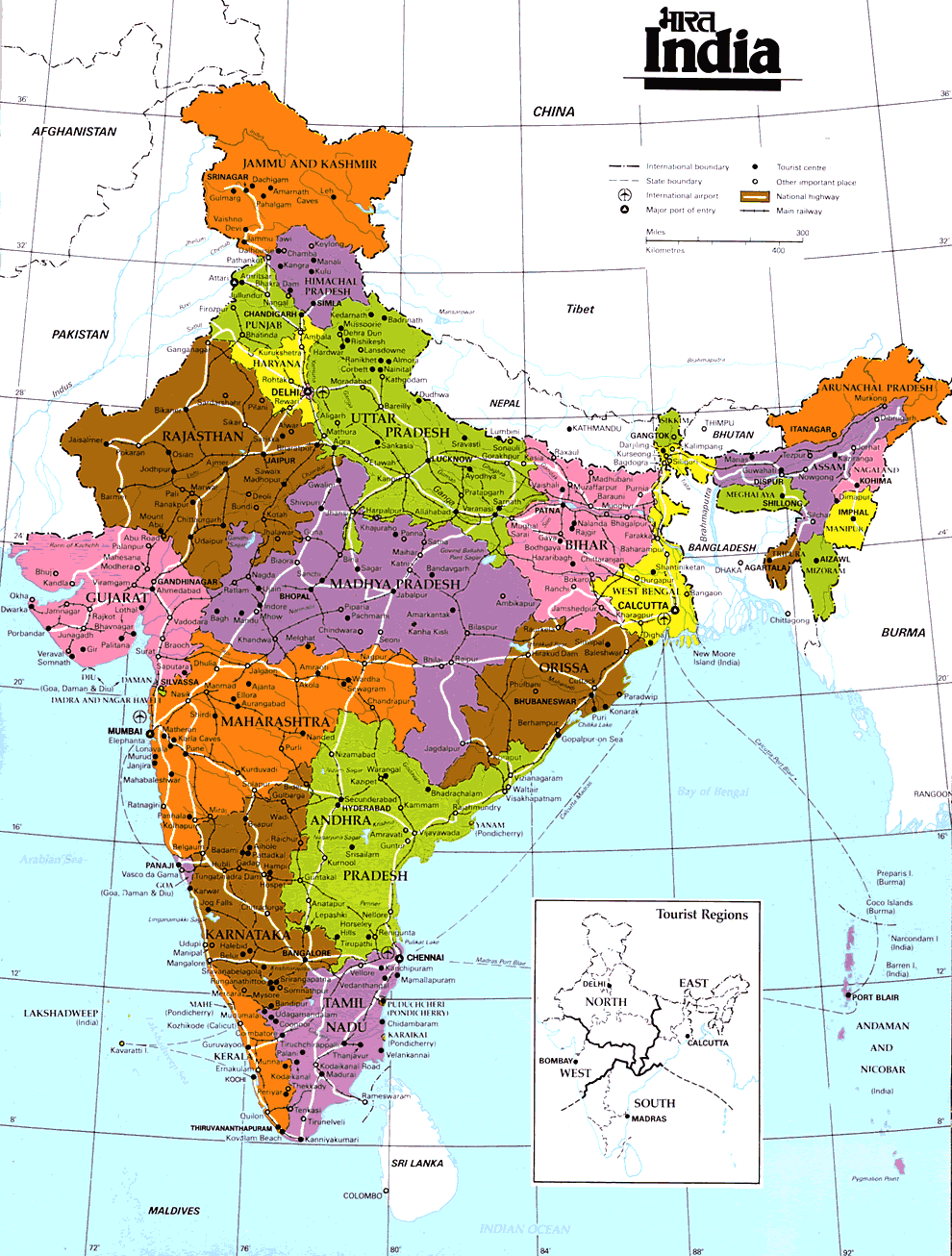
If you have a map of the findings of the 2001 Census in front of you, you will notice the following. Let's leave out places like Delhi, where population growth is significantly affected by migratin. (Perhaps this is true of Haryana and Chandigarh as well.) Let's also leave out States like Arunachal Pradesh, Meghalaya, Nagaland, Manipur, Mizoram and Sikkim, as they belong to special categories and the bases are low. Among major States it then transpires that there isn't a  major problem in Kerala, Tamil Nadu, karnataka, Andhra Pradesh, Orissa, West Bengal or Himachal Pradesh. (The deteriorating sex ratio, especially in the 0-6 age group, is a separate issue.) The population growth there is slowing down. Chhattisgarh, Uttaranchal, Punjab and Assam also don't provide much cause for worry. But population rates of growth are high in Gujarat, Maharashtra and Jharkhand, higher in Madhya pradesh and Rajasthan and Bihar, apart from Jammu & Kashmir. That indeed is the point. There is not all-India based population problems any more and there is almost a North-South divide. There are significant inter-State and inter-regional differences, with differences not only amog States, but also among districts within the same State. We do not yet have district wise figures from the provisional population totals, but they will eventually be available. To the extent that population policy is important, it thus needs to concentrate on specific States and within these States, on specific districts.
The poor and backward States of India have conventionally been referred to as the BIMARU (Bihar, Madhya Pradesh, Rajasthan and Uttar Pradesh), with a pun on the word Bihar. Bihar now has Jharkhand, Madhya Pradesh now has Chhattisgarh and Uttar Pradesh now has Uttaranchal. As the earlier identification indicates, the population growth problem is a serious one in the undivided BIMARU States and in Gujarat, Maharashtra and Haryana.
Disparities in Growth
However, post-1991 reforms, disparities in growth across States have increased and will increase even further. In States like Gujarat and maharashtra, real State domestic product has grown at rates of 6% and more and this has beneficial effects on poverty (percentage of population below the poverty line or head count ratio) and unemployment. But among the BIMARU states, real State domestic product has only grown at around 3% in Bihar and Uttar Pradesh (and in Orissa among the non-population growth has thus contributed to per capita income growth rates of 1 to 1.5%. There have thus been limited beneficial effects on poverty and unemployment. The debate about the link between per capita income growth and declines in the poverty ratio (head count ratio or percentage of population below the poverty line) has hopefully been resolved. Post-1991, this debate took place in the absence of any data, since the last NSS (National Sample Survey) large sample dated to 1993-94. The NSS large sample figures of 1999-2000 are now available. Subject to minor problems of data incomparability, at an all-India level, they show a drop in the poverty ratio from 36% in 1993-94 to 23% or 26% in 1999-2000. (23% is according to one criterion, 26% according to another.)
The relationship between population growth and economic development is a two-way one, even though we sometimes tend to forget one part of the relationship. In the classic demo graphic transition sense, an increase in income tends to bring down birth rates. In the 1991 Census, among the major States, crude birth rates were sus, among the major States, crude birth rates were more than 30 per thousand in Bihar, Madhya Pradesh, Rajasthan and Uttar Pradesh.) and as I have argued earlier, a large population can also contribute to economic growth and a negative correlation between the two is not necessarily axiomatic. In fact, in an all-India sense, the country is clearly going through a period of demographic transition now. The crude birth rate has dropped. But babies who were born twenty or twenty-five years ago, are not entering the labor force. Stated differently, the percentage of population in the productive age-groups in in creasing and the dependency ratio is declining.
Paul Krugman

Before the East Asian currency crisis, there was a lot of talk about the East Asian miracle, although that phrase is somewhat unpopular now. Several people have suggested that an economist named Paul Krugman predicted the crisis. Not quite. In his 1994 article in Foreign Affairs (not the later 1998 one), Paul Krugman argued that growth in East Asia came about primarily through input increases, not through productivity increases can occur because of increases in labor and capital, sometimes referred to as extensive growth. Or output in creases can occur with same inputs of labor and capital, if the productivity with which these inputs are used increases, sometimes referred to as intensive growth.
Once one take away the effect of increases in capital and labor, the residual growth is referred to as total factor productivity (TFP) increase. Krugman thus argued that there was little evidence of TFP growth in Eat Asia. Growth happened becuae of increases in capital (based on high savings rates) and labor inputs. Sine there was a limit to how much these could be increased, East Asian growth must eventually slow down. That was the essence of the argument. my intention is not to discuss TFP, Krugman or East Asia.
I only want to point out that there are some other studies (other than Krugman's) that have tried to decompose growth in East Asia. And these suggest that the demographic transition (drop in dependency ratio) contributed around 2% to real national income growth in East Asia. At an aggregate level, India is entering this demographic transition cycle now and this is a cycle that will last for the next twenty or thirty years. After that, it will plateau out, as it did in East Asia. The point is that such demographic transition can add 2% to real national income growth in India also, in the years leading income growth in India also, in the years leading up to 2020 or 2030.
However, two conditions have to be satisfied. First, jobs have to be found for these people. Second, these people have to possess the requisite skills, for which, the literacy rate is a useful indicator, although it is legitimate to argue that broader indicators of human development should be considered. Let us consider the second point first.
The Literacy Scene

In the 1991 Census, we had a literacy rate of 52.2%. In 1951, we had a literacy rate of 18.3%. So over a period of 40 years, te literacy rate improved by 34% or 0.85% per year. In 1997, the National Sample Survey (NSS) collected some data on literacy in the course of its 53rd round and arrived at a figure. From 52% in 1991 to 62% a year. How is that possible, when the track record has been 0.85% a year? After all, NSS surveys are not designed to capture data on literacy. No one disputes that the census is designed to capture data on literacy and we now know that in 2001, the overall literacy rate is 65%. This is an improvement of 1.3% a year and is not out of synch with the NSS figure for 1997. There are indeed people who argue that definitions of literacy don't capture much, they have no functional tests. True, but that is neither here nor there. The definition hasn't changed much. And even if the definition is unsatisfactory, as long as is does not become more unsatisfactory, an improvement is an improvement. Surely, that cannot be denied.
What has changed since 1991 so as to make such improvements believable, in defiance of earlier trends? Without getting into details, I suspect that two changes have been important. First, government-administered delivery of primary education has become more decentralized and therefore, more accountable, the Education Guarantee Scheme in Madhya Pradesh being one example. Contrary to popular perception, at the primary level, the problem is not that accessible schools don't exist. The problem is the quality of education delivered there. Second, there has been considerable NGO (non-government organization) involvement and this too, makes the delivery of education more flexible. We should be headed for an overall literacy rate of around 85% 2015.
Job Growth

I have tried to argue that we don't need to worry about the population problem if we can solve the literacy (human development) and job growth problems. Let me turn to job growth now. Clearly, the answer does not lie in jobs in the government sector, including the public sector. Provided labor laws are made more flexible in the private organized manufacturing growth does not translate into employment growth. Part of the answer also lies in employment growth in the services sector, conventionally perceived to be more labor intensive than manufacturing. Part of the answer also lies in the agricultural sector, with agriculture being interpreted as rural industries and services and not just narrow crop and livestock output. For that to happen, agricultural reforms (removal of inter-State restrictions, improvement in rural infrastructure, phasing out of controls on output sales and prices, end of inefficient subsidies on inputs, opening up of futures markets, corporate sector involvement in extension services and credit, banking and insurance) need to happen. Unfortunately, despite what has happened since 1991, agricultural sector reforms haven't been implemented. Even talking about them, at the government level, is of recent vintage.
In conclusion, population growth is not per se a problem. Economic growth is indeed a problem. In that sense, population growth becomes a problem if reforms don't happen. And there is also an inter-State dimension to this. Madhya Pradesh and Rajasthan have begun to climb out of the BIMARU fold. But what happens in Uttar Pradesh 9at least the Eastern part), Uttaranchal, Assam (the rest of the North-East also), Orissa, Bihar, Jharkhand and Jammu & Kashmir? Given the physical infrastructure there, extrapolation of present trends doesn't suggest an enormous explores doesn't suggest an enormous explosion in manufacturing activity there. Given the social infrastructure there, extrapolation of present trends doesn't suggest an enormous explosion in the service sector there. Migration cannot be a large-scale solution. At least in some of these states, agriculture and agricultural reforms hold the key. And that is primarily a State-government subject. Thanks to what has happened since 1991, the focus of policy change is now at the level acted positively? There in lies the tragedy. Let's not blame population growth for that.

Sunday, 29 April 2012


Agni-5's launch is a major milestone, India ,joined the elite club of nations


Defence minister A K Antony on Thursday described the maiden test flight of Inter-Continental Ballistic Missile (ICBM) Agni-5 as an "immaculate success" and a "major milestone". "The nation stands tall today. We have joined the elite club of nations (to possess the ICBM capability)," Antony told the DRDO chief Dr V K Saraswat on phone after the test flight of the missile was declared successful on Thursday. 
"The immaculate success of the Agni-5 is a major milestone in the country's missile research and development programme," he said. The about 5,000 km range Agni-5 was launched from a test range at Wheeler Island off the coast of Odisha at 0807 hours and took 15 minutes to reach its target in southern Indian Ocean. The missile achieved all the mission parameters and has turned out to be a huge success, defence ministry officials said.
The launch was cancelled last night due to bad weather and a spate of heavy lightning in the test range. Antony also spoke to the Agni-5 project director Dr Avinash Chander and congratulated his entire team for their hard work and dedication. DRDO took four years to develop the missile. In his conversation with Dr Saraswat and Dr Chander, Antony told them that the nation is proud of its defence scientists and recalled the contributions made by former DRDO chiefs, specially Dr M Natarajan, a brain behind success of various projects such as MBT Arjun and pioneering efforts in LCA Tejas and Pinaka MBRL projects.

AGNI- 5 LAUNCH - CHINA REACTS CAUTIOUSLY, SAYS INDIA NOT ITs RIVAL

Reacting cautiously to India's test of the Agni 5 missile, China on Thursday said the two countries are not rivals and enjoy "sound" relations.


"China has taken note of reports on India's missile launch. The two countries have a sound relationship. During the (recently held) BRICS meeting (in Delhi) the leadership had consensus to take the relationship further and to push forward bilateral strategic cooperative partnership," Chinese foreign ministry spokesman Liu Weimin told a media briefing in Beijing when asked about the launch.

In Delhi, diplomatic sources in the Chinese embassy said, "The Agni 5 launch can give rise to another round of arms race in this part of the world."
Asked whether China was concerned as most of the country would come under the Agni's range, Liu said, "Both countries are emerging powers. We are not rivals. We are cooperative partners. We should cherish the hard earned momentum of cooperation."


But China's state-run Global Times came out with a strong editorial criticising the launch, claiming that the Chinese nuclear power is more "stronger and reliable" and New Delhi has "no chance" to catch up.

"India should not overestimate its strength. Even if it has missiles that could reach most parts of China, that does not mean it will gain anything from being arrogant during disputes with China. India should be clear that China's nuclear power is stronger and more reliable. For the foreseeable future, India would stand no chance in an overall arms race with China," stated The The Global Times article further said that while India's path for boosting its military strength has not met too many obstacles, the country is still poor and lags behind in infrastructure construction.

It also criticized the West for consistently overlooking India's disregard of nuclear and missile control treaties.

It questioned why the West remains silent about the fact that India's military spending increased by 17 percent in 2012 and the country has again become the largest weapons importer in the world.

The paper warned India against overstating the value of its Western allies and the profits it could gain from participating in the containment of China. If it equates long-range strategic missiles with the deterrence of China, and stirs up further hostility, it could be sorely mistaken, stated The Global Times.Global Times.

Census 2011: Kerala continues to top literacy chart


Highlights of the 2011 Indian Census

The provisional figures of Census 2011 were released in New Delhi on March 31, 2011 by Union Home Secretary Shri G.K.Pillai and RGI Shri C. Chandramouli. Rising numbers in the literacy rate among the general population were just one encouraging results of India’s latest census reports.

Major Highlights of the Census 2011 (Provisional figures)
■The population of the country as per the provisional figures of Census 2011 is 1210.19 million of which 623.72 million (51.54%) are males and 586.46 million (48.46%) are females.
■The population of India has increased by more than 181 million during the decade 2001-2011
■Percentage growth in 2001-2011 is 17.64; males 17.19 and females 18.12.
■2001-2011 is the first decade (with the exception of 1911-1921) which has actually added lesser population compared to the previous decade.
■Uttar Pradesh (Home to popular tourist spots such as Agra, Lucknow and Varanasi) is the most populous State (199.5 million) in the country followed by Maharashtra (Home to Mumbai and Pune) with 112 million.
■The percentage decadal growth rates of the six most populous States have declined during 2001-2011 compared to 1991-2001:
Uttar Pradesh (25.85% to 20.09%)
Maharashtra (22.73% to 15.99%)

Bihar (28.62% to 25.07%)

West Bengal (17.77 % to 13.93%)

Andhra Pradesh (14.59% to 11.10%)

Madhya Pradesh (24.26% to 20.30%)

■During 2001-2011, as many as 25 States/Union Territories with a share of about 85% of the country’s population registered an annual growth rate of less than 2% as compared to, 15 States/Union Territories with a share of about 42% during the period 1991-2001.
■15 States/Union Territories have grown by less than 1.5 per cent per annum during 2001-2011, while the number of such States/Union Territories was only 4 during the previous decade.
■The total number of children in the age-group 0-6 is 158.8 million (-5 million since 2001)
■Twenty States and Union Territories now have over one million children in the age group 0-6 years. On the other extreme, there are five States and Union Territories in the country that are yet to reach the one hundred thousand mark.
■Uttar Pradesh (29.7 million), Bihar (18.6 million), Maharashtra (12.8 million), Madhya Pradesh (10.5 million) and Rajasthan (10.5 million) constitute 52% children in the age group of 0-6 years.
■Population (0-6 years) 2001-2011 registered minus (-)3.08 percent growth with minus (-)2.42 for males and –3.80 for females.
■The proportion of Child Population in the age group of 0-6 years to total population is 13.1 percent while the corresponding figure in 2001 was 15.9 percent. The decline has been to the extent of 2.8 points.
■Overall sex ratio at the national level has increased by 7 points to reach 940 at Census 2011 as against 933 in Census 2001. This is the highest sex ratio recorded since Census 1971 and a shade lower than 1961. Increase in sex ratio is observed in 29 States/UTs.
■Three major States (Jammu & Kashmir, Bihar & Gujarat) have shown decline in sex ratio as compared to Census 2001.
■Kerala with 1084 has the highest sex ratio followed by Puducherry with 1038, Daman & Diu has the lowest sex ratio of 618.
■Child sex ratio (0-6 years) is 914. Increasing trend in the child sex ratio (0-6) seen in Punjab, Haryana, Himachal Pradesh, Gujarat, Tamil Nadu, Mizoram and A&N Islands. In all remaining 27 States/UTs, the child sex ratio show decline over Census 2001.
■Mizoram has the highest child sex ratio (0-6 years) of 971 followed by Meghalaya with 970. Haryana is at the bottom with ratio of 830 followed by Punjab with 846.
■Literacy rate has gone up from 64.83 per cent in 2001 to 74.04 per cent in 2011 showing an increase of 9.21 percentage points.
■Percentage growth in literacy during 2001-2011 is 38.82; males : 31.98% & females : 49.10%.
■Literates constitute 74 per cent of the total population aged seven and above and illiterates form 26 per cent.

Kerala Police Detains Two Italian Ship Guards In Fishermen Killing Case


Kerala police on Sunday took into custody two armed personnel of an Italian vessel from which gunshots were fired killing two fishermen off Alappuzha on Wednesday.

Latore Massimiliano and Salvatore Girone, who are part of the six-member security detail of the ship Enrica Lexie from Italian Navy, were brought to the shore this evening nearly eight hours past the deadline set by the police last night.

The two were brought to the shore from the vessel by senior police officers led by Ernakulam Range IGP K. Padma Kumar, Kochi Police commissioner, M. R. Ajith Kumar, Kollam SP Sam Christy Daniel and Assistant Commissioner (Special Branch) M.N. Ramesh. Italian Consul General also accompanied them.

They were taken to a CISF guest house at nearby Wellignton island for detailed interrogation, police sources said.

IGP Padmakumar told reporters that police examined documents in the ship and recorded the statement of the 20-odd crew and the Captain.

“As the matter was very sensitive, a detailed statement had to be made,” he said adding, at no point of time they (ship crew) created any obstacles and extended their cooperation.

Meanwhile, an Italian delegation, including officials from their Legal and Foreign ministries, arrived in New Delhi on Sunday and met Indian officials in connection with the killing of fishermen by the guards on board the ship.

The visiting team discussed the case with senior External Affairs Ministry officials during which the Indian side expressed hope that the Italians will cooperate in ensuring that law of the land takes its course.

MEA spokesperson Syed Akbaruddin said both the sides had a “fairly comprehensive” discussion.

“We had a fairly comprehensive discussion whereby we have explained to them the rationale of our position and the situation as it exists today. We have also explained to them that as good partners and as External Affairs Minister S. M. Krishna had requested yesterday, we hope Italy will cooperate with us in ensuring law of the land takes its course. We also requested them to fully cooperate with Kerala Police,” he told reporters.


Official sources have said that the team will also go to Kochi for legal consultations in connection with the case.

The two fishermen, Ajesh Binki (25) and Jalastein (45) ,were killed off Kollam coast near Kerala when armed guards of the ship fired at their boat, suspecting it to be a vessel belonging to pirates.
Kerala Police officers Sunday morning began recording the statements of the crew of the Italian tanker 'Enrica Lexie', currently berthed here as part of the investigation into the killing of two Indian fishermen.

Inspector General of Police K. Padmakumar told reporters here that the investigating officers were recording the statements of the captain and other crew members.

'The investigating officers include Kollam Superintendent of Police Sam Christy Daniel. They have taken the statements from the captain and other crew members. They are fully cooperating with the process,' said Padmakumar.

An team of Kerala Police officers, as also ballistic and forensic experts, boarded the ship Sunday morning for investigations.

Top officials from the Italian Embassy were also aboard the ship and were in constant touch with authorities in Delhi.

Sources pointed out that the two security officers of the Italian ship who shot dead two Indian fishermen four days ago are likely to be taken into custody by the police.

Two fishermen, Ajesh Binki, 25, from Tamil Nadu and Gelastine, 45, from Kerala, were mistaken as pirates and shot dead by the crew of the Italian cargo vessel on Wednesday evening, about 14 nautical miles off Alappuzha.

The owners of the ship had late Saturday agreed to cooperate with the inquiry.

Two Italian Marines arrested by Kerala Police
Indian diplomacy ended four days of Italian defiance on Sunday, allowing the Kerala Police to arrest two members of Italian ship Enrica Lexie's security team who allegedly shot dead two fishermen off the state's coast on Wednesday.

Marines Latorre Massimiliano and Salvatore


Girone, part of the six-member security detail of the ship - from the Italian navy - were arrested nearly eight hours past the 8am deadline set by the police for the ship's authorities to turn them over.
"They will be handed over to the Kollam Police and produced before a magistrate," Ernakulam range inspector general of police K Padmakumar said.


Though the police had sought the custody of six people, they later zeroed in on the two for the killing of fishermen Ajesh Binki, 25, and Jalastein, 45.

The Italians had fired on their boat after mistaking them for pirates.

The breakthrough came after the Centre rejected arguments offered by a special Italian delegation in New Delhi to stave off the arrests.

The Indian side insisted that the ship's crew would have to face trial in India.

Kochi city police commissioner MR Ajith Kumar and his team reached the ship, berthed in Kochi port, in the morning and started quizzing the accused. Italian consular general Giampaolo Cutillo was present when the arrest took place.


A murder case was registered against them at Neendakara costal police station. The arrested will be questioned at Kochi police club and later produced before the magistrate. A team of eminent lawyers is camping in the city to assist Italian authorities.

Though the police had sought the custody of six crew members later they zeroed in on two, believed to be Italian navy commandos, who fired at unarmed fishermen.

“If needed we will add more after questioning the arrested,” a senior police office said when asked about this.

“It was so cumbersome and irritating. Since diplomatic strings were attached we showed utmost restraint and patience,” the officer said ridiculing the Italian authorities delay tactics showing flimsy reasons.


Throughout the talks Italian authorities insisted that India could not take action against them as the incident occurred in international water.

However its claim did not wash with the regional commander of Coast Guard (west), inspector general SPS Basra, who said the fishing boat was in Indian exclusive zone when it was fired upon.

Kerala director general of police Jacob Punoose also maintained that the firing took place in Indian waters and the country has every right to book them under Indian laws.


After the firing the Indian Navy and Cost Guard vessels had escorted the 58,000 tonne merchant vessel — carrying crude oil and cargo from Egypt to Singapore — to the Kochi Port. The ship’s crew includes 19 Indians.

The ball started rolling after the Prime Minister’s office sought a report from both home and external affairs ministries and Kerala chief minister Oommen Chandy toughened his posture calling it a ‘cold-blooded murder.’

EFFECTS OF ENDOSULFAN IN HUMAN BODY

HARMFUL EFFECTS OF ENDOSULFAN

VICTIMS OF ENDOSULFAN


Between 1976 and 2000, more than 50,000 villagers of Kasargod district in Kerala, India have been exposed to endosulfan, a persistent organic pesticide, sprayed on the cashew plantations owned by the Plantation Corporation of Kerala. More than 3000 people living near, downstream and downwind of the estate were affected by debilitating rare diseases like mental retardation, cerebral palsy, cancer etc. In response to the peoples’ agitation, the National Human Rights Commission (NHRC) mandated the National Institute of Occupational Health (NIOH) to investigate the issue in 2001. NIOH observed that “aerial exposure” to endosulfan was responsible for delay in sexual maturity among the adolescents. In the final report submitted to NHRC and the Ministry of Agriculture, Government of India, NHRC categorically stated that they did not see any serious diseases like cancer or mental retardation in the villages they went. They recommended a detailed epidemiological study and long term monitoring for cancers of the endocrine system in the affected villages

I would like to invite you to Kerala-famously known as God’s own country. Kerala in South India is flanked by the Arabian Sea on one side and the Sahayadri’s on one side and as a result this South Indian state has a lot to offer nature buffs in terms of exotic flora, natural greens and of course birds and wild animals. Evidently Kerala, South India is a land of immense natural beauty and offers undulating stretches of lush green forests generously sprinkled with gurgling waterfalls, colorful blooms, animals and chirping birds. All this and more add to the natural beauty of this picturesque state. Famous for its greenery and natural beauty Kerala is a world famous tourist spot. Kerala has uppermost literacy rate in the nation. But Education and lust to earn more have made keralites fools. They have started clearing paddy fields and coconut farms and turned into cash crops such as rubber and cashewnuts. In the run to greater yield Malayalees are using unethical and harmful pesticides in cashew plantations.


Now let’s visit a district in Kerala – Kasaragod, once known for its greenery today Kasaragod is haunted by diseases and tragedy. Thanks to hamlets of cashew plantations spread along the district. The diseases are side effects of Endosulfan a deadly pesticide sprayed in these plantations. The UNO classifies Endosulfan as highly dangerous insect killer and banned in 62 countries
Endosulfan should be completely banned.We have to study from experiences. but the Central Govt is supporting the corporates and the policy makers are the agents of the corporates. The use of endosulfan will damge the the soil fertility also. The microorganisms of the soil will be completely damaged and in few years our agriculture will be utter failure.


The insect killer was sprayed aerially with in particular used helicopters. As the plantations are mostly in mountainous areas, the pesticide drains and gets washed down the slopes during rains into drinking water below. Consuming this water will result in diseases ranging from physical deformities, cancers, birth disorders and damages to brain and nervous system. During 2000-2001 the victims got huge media introduction and resulted in Study on the victim’s. The study of Endosulfan effects showed larger abnormality such as mental retardation, cancer and infertility in the victims. But the pesticide and fertilizer industries were very fast to refuse the studies. Endosulfan is manufactured and distributed in India by Hindustan Fertilizers limited. Endosulfan has been banned in Kerala. People are still facing the side effects of Endosulfan in Kerala and Karnataka but the Indian Government has not yet banned the deadly chemical. The Pesticide is still used for cotton and Cashew plantations in many parts of the nation Karnataka, Punjab, Assam and Andhra Pradesh. India needs an effective chemical norm and should ratify a chemical & pesticide policy which would help people affected from chemical accidents & disasters; also stop usage of deadly pesticides for agriculture. Even during the Bhopal gas tragedy Government did nothing for the victims. The victims of Endosulfan also were turned down by the Government. It is clear that all these chemical disasters are due to ignorant and negligent policies from the Government.
The Exposure Pathways
All the environmental media studied have been contaminated with endosulfan. The main routes of entry into the human body are:
1. From mother’s body to foetus via placenta– 36 weeks – Placental Exposure
2. From mother’s milk to baby – 36 months – Maternal Milk-borne exposure
3. From locally grown plant and animal foods – egg, milk and meat – chronic, perennial – Food borne exposure
4. From water – Chronic and perennial – Water borne Exposure
5. From air through breathing and through skin – Few hours till the vapour remains suspended in air. – short duration. – Aerial Exposure
Those who are exposed through the first three pathways, will also be exposed to metabolites – stress chemicals – that are generated by the living systems in response to the exposure. Cattles with congenital anomalies and cancers are more likely to be sold for slaughter

: Union Minister K.V Thomas’ statement backing Endosulfan pesticide is humiliating the hapless victims of Endosulfan disaster in eleven Panchayaths in Kasargod district, states P Mujeeb Rahman, State Head of the Solidarity Youth Movement. K.V Thomas earlier said that Endosulfan did not have any adverse affects in Kasargod.

Saturday, 28 April 2012


Unemployment


An idle man cannot find food for him. In order to live he must do some work. Some occupation is necessary to enable man to satisfy his wants. Everywhere in this world there is a constant struggle for an occupation.
Only deserving people win the struggle and get occupations. Those who are defeated suffer starvation and misery. In our country many persons are unemployed. Their number is very large. Unemployment problem is a great problem in our country.
There are many causes of unemployment. The chief among them is the rapid growth of population. Chances of employment are decreasing day by day due to the use of machines which save labour.
Lack of skill and ability is another cause of unemployment. An unskilled labour cannot be successful in any work. If a chance of employment is created, only the skilled labour avails it.
Our system of education is also responsible for the problem of unemployment in our country. Vocational subjects are not compulsorily taught in school and college. Students are reading some superficial subjects and are trying to get through with high marks. Their attention is on securing marks, not on the effectiveness of the subject in their practical life.
Students are jobless after their education. M.K. Gandhi attached great importance to manual labour. But in the present system-of education, no student learns it. Self- employment is, therefore, a dream in our country.
Ill health is another factor of unemployment. Majori of the Indians do not get proper treatment of their illness Physical fitness is a criterion for getting a job. Nowadays more and more industries are set up in our country. Although there are chances of employment there, the hazardous atmosphere of the industrial area discourages people to go for employment there.
Cottage industries are neglected. Agriculture is done in old method. Therefore it is an unprofitable occupation now-a-days. Political people are talking very high about unemployment. But they are not sincerely doing anything for providing employment to the young men and women in our country. Only political propaganda cannot solve the problem.
Unemployment is a social problem. Many other social problems are born from it. The unemployed youth are growing more and more rebellious. Their attitude to education, interest for genuine qualification and faithfulness to our society decrease.
Dacoit, blackmailing, treachery and dishonesty grow rampantly. Moral perversion also occurs. There is no respect for the seniors. In a family, the unemployed children create disturbances. They feel frustrated. They kill either themselves or their parents. Thus social tension is born. Gradually, our culture of love and tolerance is converted to the culture of anger and maladjustment.
There is still some hope to remove unemployment from our country. Firstly, our educational system must be reformed. Vocational subjects must be compulsorily taught to our students. Stress must be given on manual labour and self- employment.
Most important of all is to check corruption and nepotism in our country. Ministers and important persons in high positions are now accused of showing favour and sympathy to their own relatives. Further, they are accused of selling jobs at high price. Thus, the children of the rich get employments by paying.


Globalization in India


For a long time since Nehru's days, India followed the model of 'mixed economy'. Its economic philosophy was 'democratic socialism'.
For a long time since Nehru's days, India followed the model of 'mixed economy'. Its economic philosophy was 'democratic socialism'. As Nehru himself believed in socialism, he did not have faith in rich people. He was of firm view that the rich exploited the poor. Therefore, his government laid stress on the development of poor, and the state was given the main responsibility for this.
Nehru viewed state as the main agency of economic development. In the regime of mixed economy, security of country, social welfare and economic development were mainly the responsibility of government. The public sector was under government control. Other industries were in the hands of industrialists.
Nehru's mode! Of economic development lasted long. But in course of time it became clear that the industries in the public sector were incurring heavy losses while private industries were making big profits. The weakness of Indian economy was exposed in the middle of 1980s. The government faced a serious foreign exchange reserve crisis. It miserably failed to repay the debts taken from the World Bank and the IMF.
Against this background the Narasimha Rao government, adopted the New Economic policy in July 1991. The main elements of this policy were liberalisation and privatisation which were also the elements of globalization. The Finance minister in the Rao government was an eminent economist, Dr. Manmohan Singh who is now the Prime Minister of India.
The introduction of New Economic Policy by the Rao government was part of India welcoming globalization. Free economy and market economy received boost. Thelicense raj was discarded. The government control over economy largely loosened.
The importance of public sector decreased, and that of private sector increased. As a result of this, India's economy had a turnaround within a short period. The foreign exchange reserve crisis was successfully tackled, inflation decreased and the rate of economic growth increased.
The economic growth that globalization gave to India was praised not only in India, but also abroad. The fear of Indian industrialists and business people that they would be great losers because of globalization did not prove to be true.
On the other hand, some of them successfully competed at the international level and took over some major industries and business concerns of other countries.
But, in course of time, some bad consequences of globalization were felt. These harmful effects were:
1. The importance of state in the economic field decreased. Capital was withdrawn from many industries in the public sector.
2. Market economy was encouraged and private sector became more influential.
3. The ordinary people suffered a lot as the state largely withdrew from the field of social welfare. The poor suffered most as MNCs and other private companies entered the fields of education, health, insurance and banking etc.
4. Many small industries and cottage industries were closed. They could not compete with big industries - either MNCs or other big private industries.
5. There took place increase in unemployment. As big industries in the private sector got many of their works done through mechanized machines, many employees were fired from jobs, and there was hardly any fresh recruitment.
6. Women, in particular, suffered a lot. More than male employees, female employees lost their jobs, and the small number of employees who were recruited was mostly males.
Globalization is capitalism in its globalized form. In fact, capitalism enriches itself only when it makes the globe or a number of countries its field of operation.
The end of the cold war marked the victory of capitalism over communism. Capitalist democracy has decisively won, and communism has accepted defeat. This, Fukuyama claims, marks the 'end of history'.
For the time being capitalism has come to stay, and there is no alternative to capitalism. Those who until the other day, bitterly criticized capitalism have willy-nilly accepted it. Now the choice is between neoliberal capitalism advocated by neo-conservatives of the west and regulated capitalism, advocated by liberal democrats of many developing countries.
As it seems, globalization is irreversible. The challenge is to force it to have a 'human face'. Globalization will be universally acceptable only when it brings freedom, rights, peace, security and economic benefits to the vast number of people across the globe that have remained poor, weak and deprived.